How a 16-State Team Helped the American Oystercatcher Rebound
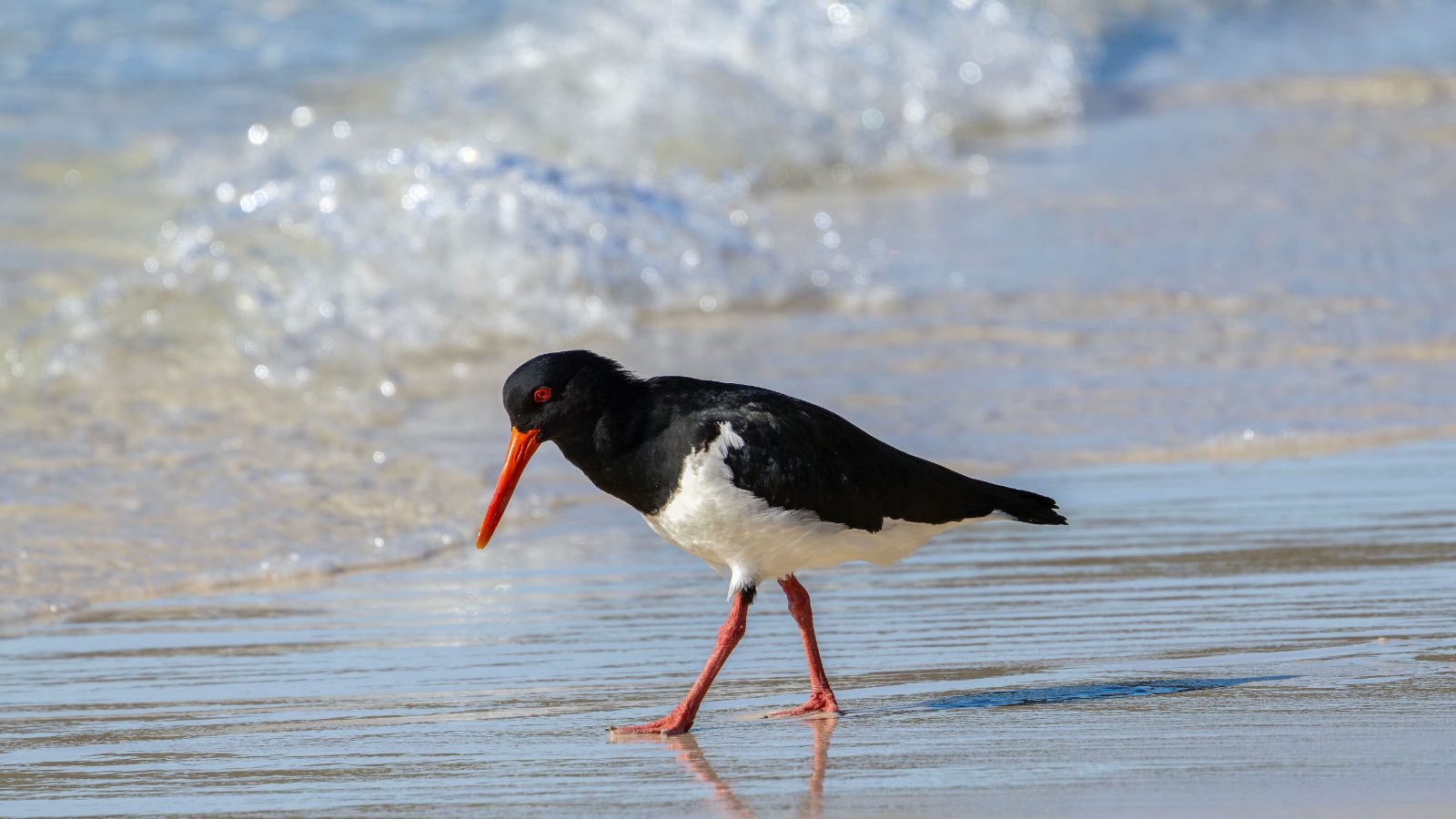
The American oystercatcher is hard to miss: a shorebird about the size of a football, with a bright orange bill it uses to pry open oysters and mussels, peach-colored legs, and a call that carries down the whole beach. A century ago, hunting and egg collecting had all but erased it from New England. Today it is one of the few North American shorebirds whose numbers are climbing while most others fall.
Between 2008 and 2023, the oystercatcher population along the Atlantic and Gulf coasts grew by 45%, a turnaround the Associated Press reported from a Rhode Island beach where the work happens one bird at a time. At Trustom Pond National Wildlife Refuge, a team of biologists chased down two chicks, tucked each into a white pillowcase, carried them to a dune to take measurements, and clipped colored bands onto their legs. “There is a problem. They can fly,” Manomet Conservation Sciences biologist Alan Kneidel said as a chick he had been closing in on lifted off across the mile-and-a-half beach.
The recovery began with a diagnosis. Plenty of adult birds were surviving, but far too few chicks were living long enough to fly, and “chick survival was the big thing driving the declines,” Kneidel said. The reasons changed from beach to beach: people getting too close at one site, raccoons and foxes at another, the sea itself washing over low dunes and drowning nests at a third. Shiloh Schulte, the shorebird scientist who led the American Oystercatcher Working Group, flew the early aerial surveys that put hard numbers on the losses. Schulte died last year in a helicopter crash in Alaska during a mission to protect shorebirds, and the network he helped assemble carried the work forward.
Because each site had its own problem, each got its own fix. On Martha’s Vineyard, crews string a low chicken-wire fence across the entrance to a key nesting beach every season to keep skunks and raccoons away from the eggs, and post bright signs so beachgoers know to give the birds space. South Carolina ropes off close to 30 breeding sites. Georgia and North Carolina rope off their beaches too and trap predators during nesting season. The oystercatchers also borrow protections meant for piping plovers, whose threatened status keeps dogs and vehicles off shared stretches of sand. “With a little bit of focused effort and attention on this really charismatic bird, you can teach the public how to share the shore,” said Luanne Johnson, founder of the Martha’s Vineyard nonprofit BiodiversityWorks, where breeding pairs are up 77% since 2009.
It helps that oystercatchers bend to fit their surroundings. Ted Simons, who has studied them on North Carolina’s Outer Banks since 1995, has watched them nest on rooftops in the United States and, in one memorable case, in a pothole at an Iceland bus station. “What we found is that these birds are incredibly adaptive,” he said. A few have even become local celebrities: Dark Green 06 and Yellow 25, both banded back in 2004, are still followed by name. Across North Carolina, breeding pairs have risen nearly 20%, to 403.
The comeback was a group project. Roughly 35 coastal organizations across 16 states pooled about $10 million over a decade, with Manomet coordinating the monitoring so everyone measured success the same way. The next test is the ocean. Rising seas and erosion keep washing out nests, so Georgia now builds raised platforms of oyster shells and rebuilds nesting islands from dredged sand, while Audubon replenishes old shell beds along the Cape Fear River. The goal, said Audubon North Carolina biologist Lindsay Addison, is to “provide the habitat that we can so they can get through this next bottleneck.” For a bird that vanished from New England a hundred years ago, getting through now looks within reach.