How Sacramento Neighbors Turned Their Front Yards Into Cooling Stations
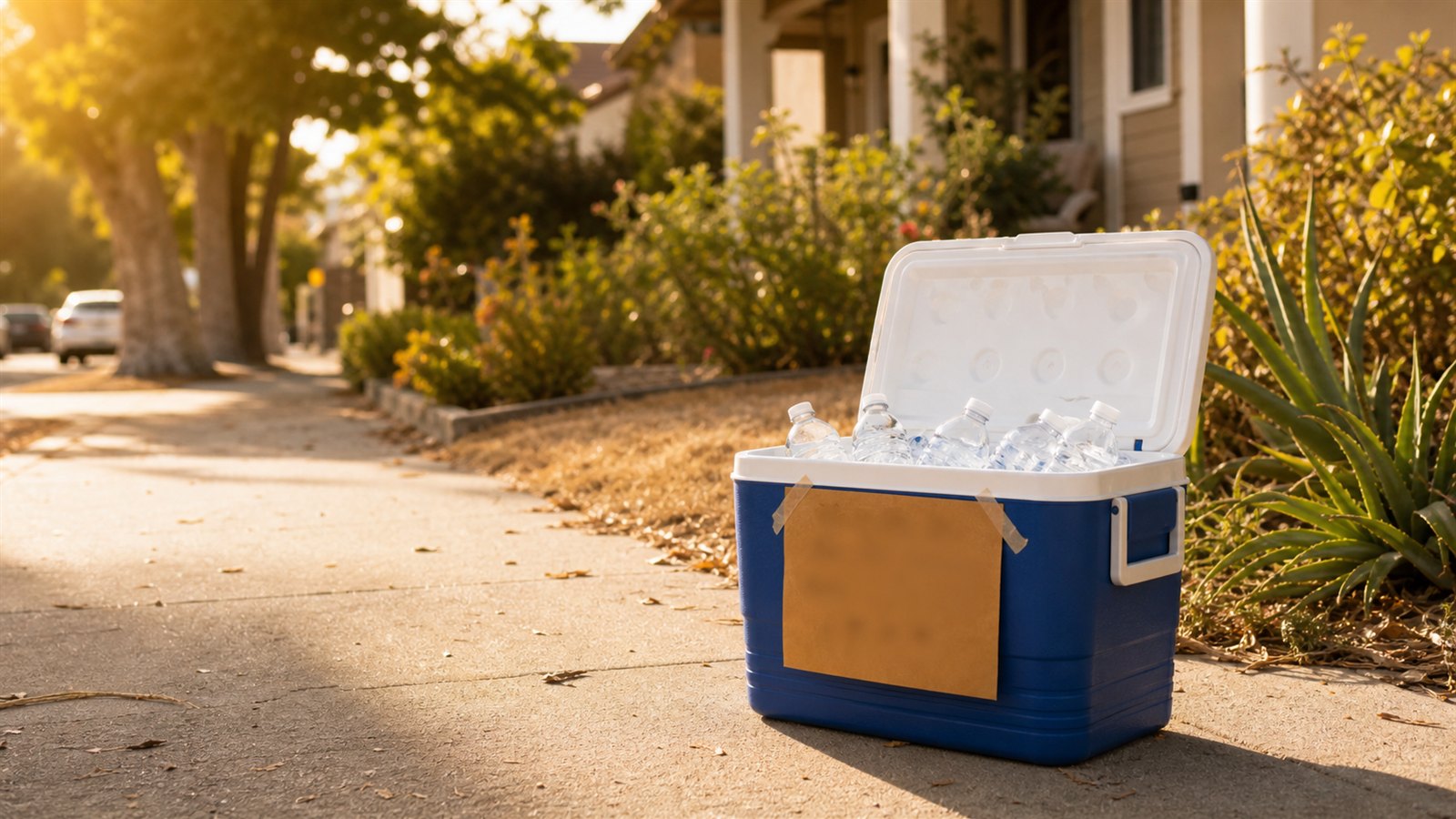
On a busy street in downtown Sacramento, there is a cooler chained to a tree. Inside is ice and bottled water, and a laminated sign on top makes the offer plain: anyone walking by can help themselves. The chain is there for a practical reason. Joe Robustelli lost an ice chest once, so now the cooler stays where he can find it and keep refilling it.
On a hot day, that cooler empties fast. Robustelli has watched more than 200 water bottles leave it between morning and evening. More than once, he has come back to find a handwritten thank-you note left on it.
Robustelli is one of dozens of Sacramentans running what they call pop-up cooling stations, and the whole kit is minimal: a container, some ice, water, a sign. He works at Alchemist Community Development Corporation, a local food-system organization, and spends part of his summer helping neighbors get stations of their own going and topped up.
“Don’t overthink it,” he says.
There is a reason the coolers keep appearing. By a Sacramento Bee analysis, seven of the last ten summers in California’s capital have ranked among the hottest on record. Cities also tend to run hotter than the land around them, by as much as eight degrees, a gap you can feel coming off asphalt and off any stretch of sidewalk with no tree to stand under. And that heat does not spread evenly. Some blocks have shade and relief that others do not.
A cooler on the corner does not change any of that. What it changes is whether there is cold water within reach of the person who happens to be on that block when they need it.
The idea started small. Alchemist set out its first station in 2020, a summer stacked with the pandemic, nearby wildfires, and extreme heat all at once. That first one went in a community garden and offered shade, a few chairs, and water. It caught on from there. By the peak of summer 2024, there were 42 stations spread across the city.
As the network grew, it changed hands. Alchemist has scaled back to a few key sites, and a mutual-aid group called Tortuguita Community Pantry now coordinates the citywide web of coolers. Reasons to be Cheerful followed how the model spread from one garden to a whole map of front yards.
Part of what makes it travel so well is that there is nothing to administer, no sign-up sheet, no form, no test of whether you are hot enough or needy enough to deserve a bottle of water.
“There are no barriers to people using it, so it truly is meeting people where they’re at. It’s a non-judgmental way to build community with everyone,” Robustelli says.
For anyone who wants to try it, organizers keep the guidance short. Put your station somewhere busy and out in the open rather than on a quiet, shady side street, because the people who most need water are the ones stuck in the sun. And use a container you would not mind losing. Robustelli’s answer to that last part was the chain and the tree.
The stations ask little of the people who run them, which is a large part of the point. A bag of ice and a case of water can turn a front yard into a place a stranger can count on for the length of a heat wave. The person restocking it never has to know who drank from it, and the person reaching in never has to explain why.
“This is very grassroots. It’s people in the community who are really managing them. It’s such an easy lift to provide some relief to those in your community that need it,” Robustelli says.