The Man Who Carries Shelter Dogs Through New York on His Back
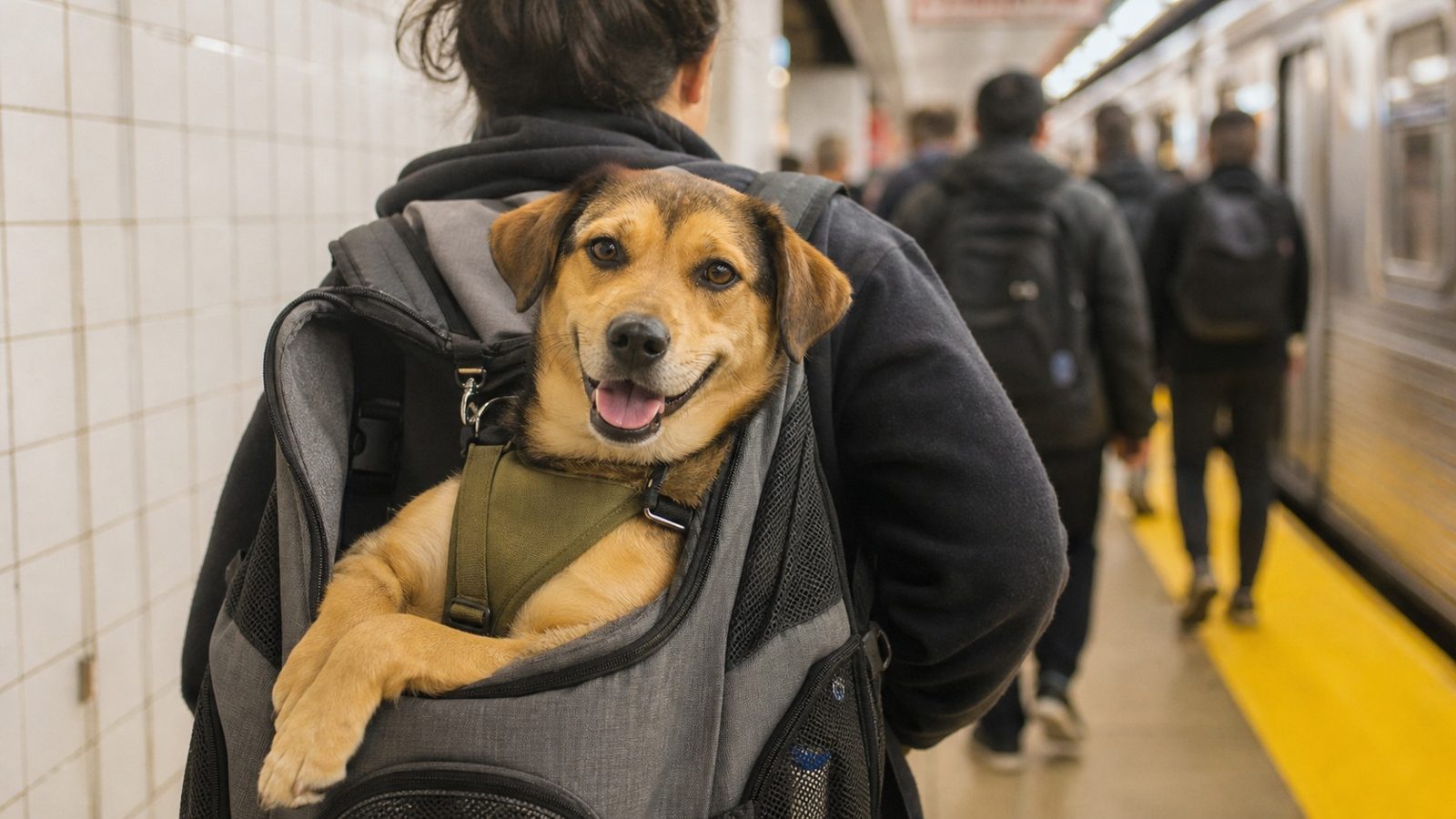
The dog on Bryan Reisberg’s back does not know it is auditioning. It knows it is on a subway for the first time, that the man carrying it keeps stopping so strangers can say hello, that there was a pup cup from Starbucks earlier and a new toy before that. As far as the dog is concerned, this is simply the best day it has had in a long while. Which is the whole idea, because the backpack it is riding in has the words “Adopt Me” stitched across it, and by tomorrow, more likely than not, the dog will have a home.
This is what Reisberg does now. Once a week he walks into a shelter in New York, lifts an adoptable dog onto his back in a specially built carrier, and takes it out to meet the city. The story was reported by Best Friends Animal Society.
It started with a corgi in a backpack
Reisberg, a filmmaker and one-time advertising creative director, did not set out to save shelter dogs. He set out to bring his corgi to work.
When New York’s transit authority required dogs to travel in carriers on the subway, Reisberg could not find one he liked for his corgi, Maxine, so he built one. He spent two years on it with product designers and vets, and the result became a small pet-goods company, Little Chonk. The videos of Maxine riding the subway in her backpack, meanwhile, did what good videos do. Serious commuter faces turned into smiles. The pair went viral, and Maxine, known online as the dog in the backpack, gathered a following in the millions.
Then last summer Maxine needed surgery and a spell of crate rest, and Reisberg had an empty backpack and an audience of animal lovers with nothing to look at. A friend suggested he fill the seat with dogs who actually needed the exposure.
So he reached out to Best Friends Animal Society and, one day in July, walked into their SoHo adoption center and walked out with Axl, a goofy eight-month-old, riding on his back. “That was two hours of pure joy,” Reisberg told Best Friends’ own magazine. “If that ride hadn’t gone well, who knows if I would’ve kept going. Axl made everything possible and opened my eyes.” The video of Axl reached more than three and a half million people. Axl was adopted. Reisberg was already planning the next one before he had returned the first. “When I brought Axl back and was cuddling with him, I was already thinking about how fast I could come back and do it again with another dog.”
The dogs get a day. The city does the rest.
The formula is disarmingly simple. Reisberg picks a dog, often a big one, the kind that tends to sit in a kennel for months while smaller dogs get chosen around them. He gives it a proper day out: the subway, a wander through Central Park or Times Square, a toy, a treat, and hours of strangers stopping to meet it. He films all of it, adds the polish of a man who used to do this for a living, and posts it with a link to adopt.
Then the internet takes over. Take Pear, a five-year-old with a weakness for hot dogs. Best Friends recounts that within a day of her video going up, applications flooded their website, and she was adopted by a man upstate who saw in her the dog he had lost years before. Bertha, a bulky white dog who rode piggyback through Queens handing out slobbery kisses, was adopted by a family on Long Island soon after her video ran. Some two dozen dogs have taken these rides. Best Friends reports that all but one have found homes, the exception a dog with a medical problem they are still working to place.
The scale of it is easy to miss inside all the sweetness. Best Friends says that since Reisberg began his outings, dog adoptions over the comparable stretch ran to 379, against 198 the year before. Their own marketing staff are careful not to claim he did that single-handedly, but as one put it, “We can definitely say he played a role.” His videos have passed a hundred million views, and this year the work earned him a Webby Award. None of which is the number he cares about.
“It’s changed my life,” he told the magazine. He had always assumed that the specific dog he wanted for his family could only come from a breeder. The rides taught him otherwise. “But whatever dog you want, that exists in a shelter.”
The best day, and the one still coming
The charm alone would be enough: a man, a backpack, a parade of happy dogs, a city full of people who stop to smile. But the reason it works is heavier than charm. An estimated 200,000 dogs were put down in American shelters last year, most of them for the simple crime of having nowhere to go. What Reisberg has figured out is that the fix is partly a visibility problem. A dog nobody sees is a dog nobody adopts. A dog on the subway with its tongue out, in front of a few million people, is a dog with a shot.
He is honest that he cannot take every one of them home, though he clearly wishes he could. He told the magazine how he thinks the whole thing ends. “One of these days, you’ll see a video where the dog doesn’t go back to the shelter in the end. Instead, he’ll be coming home for good with me.”
Until then, there is another one waiting on Monday. A big dog, probably, that has been overlooked for too long, about to have the best day it can remember, up on a stranger’s back, meeting the whole city on the way to meeting the person who takes it home.